

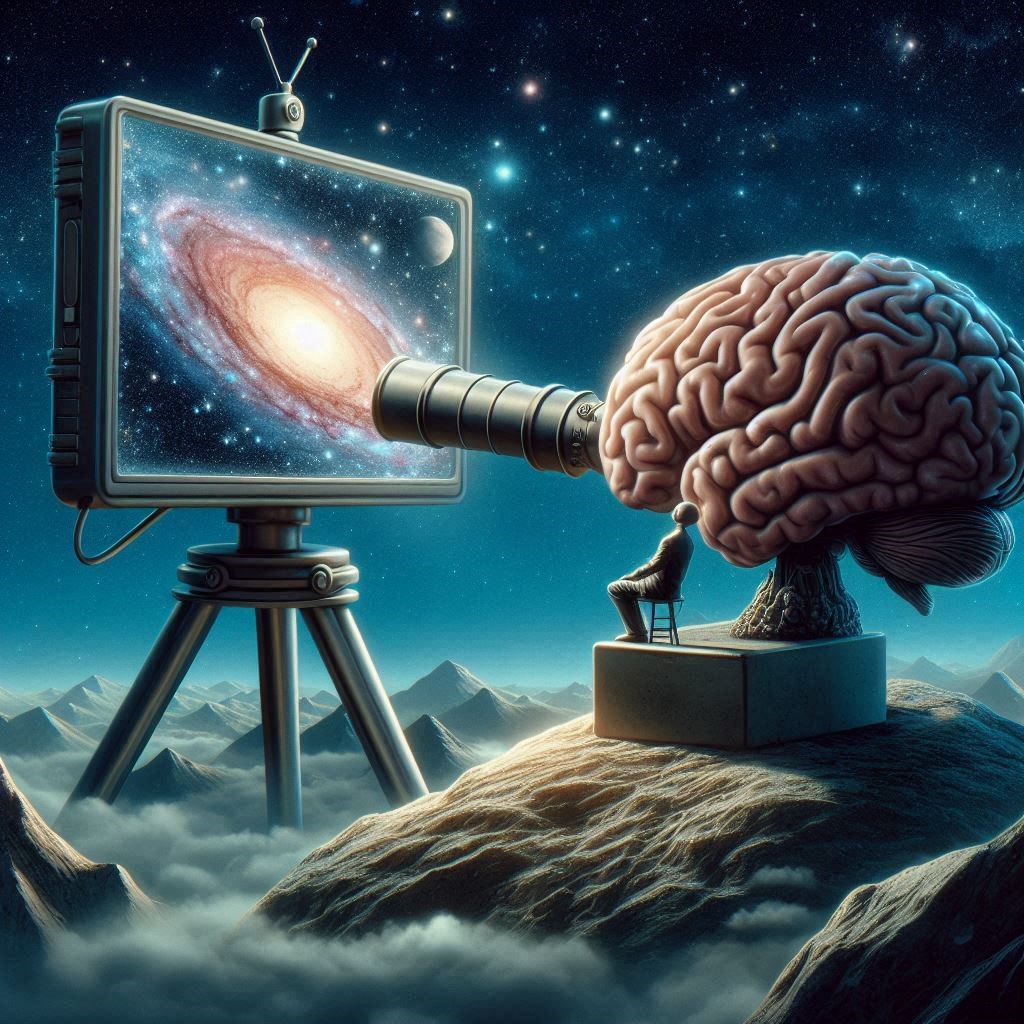
From managing your to-do list for the day to wondering why there is something instead of nothing. That is a massive gap. I was just thinking about this again. It can be overwhelming. The shift in perspective is so great. From thinking about what’s right in front of you to to thinking about the origin of the universe. Yet we focus on the day-to-day. There are so many of these massive questions that remain unanswered. How did the universe come about? What was before the universe? The moon, which we see every night, is still not well investigated. We confirmed there is water there. That’s nice. Lake property on the moon. It’s a start. But think how little we still know about our own solar system. These are things we see with our eyes, but we haven’t figured them out.
Another problem I’ve been thinking about is that for centuries, philosophers have tried to define reality. But they were working with a very narrow view of reality and little knowledge of the brain. Donald Hoffman has suggested our perception could be very different from actual reality. Most people ignore this idea, but some deal with it. I know that everything I experience through my five senses is happening within brain circuitry. We know a fair amount about that. So everything I think is reality is a filtered version. Compressed. Distorted. But still adaptive. That’s how the brain works. It is fascinating, maybe disappointing or scary, but that’s how it works. What we think is reality is not reality. Visual illusions are a simple example. The brain can be tricked. You can show that two lines are objectively the same length, yet your brain interprets one as longer. It’s a nice little demonstration of how reality is altered. But take this further, is the world actually anything like what our senses tell us? The amount of filtering could be even more extreme, where these simple illusions are just layered on top of much more significant illusions about our world.
Now, if we agree that the reality of our species and all others evolved essentially for replication, then all organisms are designed for that. Think about a species that has gone extinct. What was its purpose? Ask every scientist and philosopher, what was the point of this organism based on its genes and its interaction with the environment? The simplest answer would be replication. That is what we think evolution is about. Darwin laid out the process. That is how we got here. That’s how all organisms got here. Reproductive fitness. The simplest and most reliable goal to apply to any species is replication. Stick around as long as you can, make as many copies as possible. Then what? What does that do for the planet or ecosystems?
Humans like to have purpose. We want fulfillment. We want to work toward goals. Not many people say reproduction is their purpose. Although they’re proud of their children or grandchildren, and that may be the most rewarding part of life, we don’t directly tie fulfillment to the number of offspring. If there was a correlation, then someone with six children would be twice as fulfilled as someone with three. That would be an interesting study. Maybe it’s been done. My guess is there’s some association but not a clear correlation. Not by number. More by the experiences that come from having children.
Everyone is searching for purpose. Religion provides a context for this for many people. Personal fulfillment comes from following what their religion tells them. That’s a big one. Other people, whether religious or not, get purpose from their jobs. Their identity is wrapped in what they do. Another way to think about it is to ask what makes you proud. What is your identity? Now zoom out. Take the big picture. Across all of human knowledge, there is no evidence that life is serving a larger purpose. Maybe this will change some day, but today that is our situation. And some people can say, sure, I agree with that. So the mystery to me is this. If someone is super fulfilled by their job, they would identify with it, and spend a large majority of their time thinking about it. So they would have less time to think about the bigger mysteries of life and less time to incorporate these into their personal identity or purpose. But as most people get older, closer to the end, that is when a reflection shift typically occurs. But I wonder, how many people think like this before the end?
Religion probably represents the most common example of people reflecting on the big questions, but is it really? Or is religion just providing fictitious “filler” answers to the many big unanswered questions? I like to think about our ancestors 10,000 years ago. Their brains were not much different from ours. They were capable of reflection. They didn’t have any science. They were just figuring out how to grow food. So many things would have seemed mysterious. Like lightning. Thunder. No explanations. Just the need to make sense of it. This is how religion and religious behavior was likely born, gradually accumulating a complex set of beliefs based on fear of the unknown and a drive to understand the world around them. I think it would be a great experiment, though unethical, to raise kids in an environment that would match what would have existed 10,000 years ago. Like The Truman Show, but prehistoric. A full dome ecosystem. Just watch how culture and religion develops. They wouldn’t speak any known language. That would be a challenge. You can’t just throw in babies. They need parents. But the parents would know too much. Maybe there’s a workaround. Maybe not. It’s just a thought. But at least you could simulate it.
Driving to the hardware store, stressed about teaching, upset about missing deadlines, and suddenly you think, what am I doing here? What is this experience I’m having? And then I remember. I don’t know anything about why there’s something instead of nothing. That thought came to me today, again. Even if there is something, how well do we know what it is? Our brains interpret everything. How much is filtered and reconstructed? We don’t interact with the environment directly. It’s all indirect. When I touch something, I feel it in my fingers, but that’s the brain. It’s not happening in the fingers. So the reality is altered. Is it altered by fifty percent? What if my experience is only half of what’s actually there? If we were in a simulation, that would explain it. The simulation theory just takes it a step further. I’m not saying we aren’t here. I’m saying the reality we experience may be completely different from what it actually is. And there are facts backing that up. It’s not even debatable. You can get caught up in that thinking and completely forget about the universe’s origin. I don’t even know if the desk in front of me is what I think it is. The simulation idea says maybe I’m not even real. Just an experience running in some super advanced program run by aliens. This idea used to be the brain in a jar, sitting on a counter in a lab somewhere. That was something we talked about in grad school. Once you understand that everything is happening in the brain, you see how misleading it is to trust your common sense about experience. But you can’t go about life thinking this way. You can if you’re a philosopher and surround yourself with books. But if you want to live a mentally healthy life and end with as little regret as possible, you have to think differently. Regret itself might be something we invented. There’s no inherent reason why regret should exist. Maybe you could find an evolutionary basis for regretting not having more offspring. But just the idea of regret, especially near the end of life, is strange. You’re already past the age of reproduction. Yet people say they don’t want to have regrets. Everyone does. I’d like to remove the concept of regret from my mind. I don’t see a purpose for it.
So what should people do with their lives? Good question. There’s no way to think your way to an answer. Thinking uses the brain, and the brain itself is a mystery. I know happiness and peace. I know sadness and pain. We all want to minimize sadness and maximize happiness. Everyone would agree with that. Some exceptions, but generally yes. Limit pain from random violence, accidents. No one wants that. We want peace. That could be a purpose, help maintain the ratio in favor of happiness and peace. Other than that, it’s just details.
 Neurophilosophy Cafe